
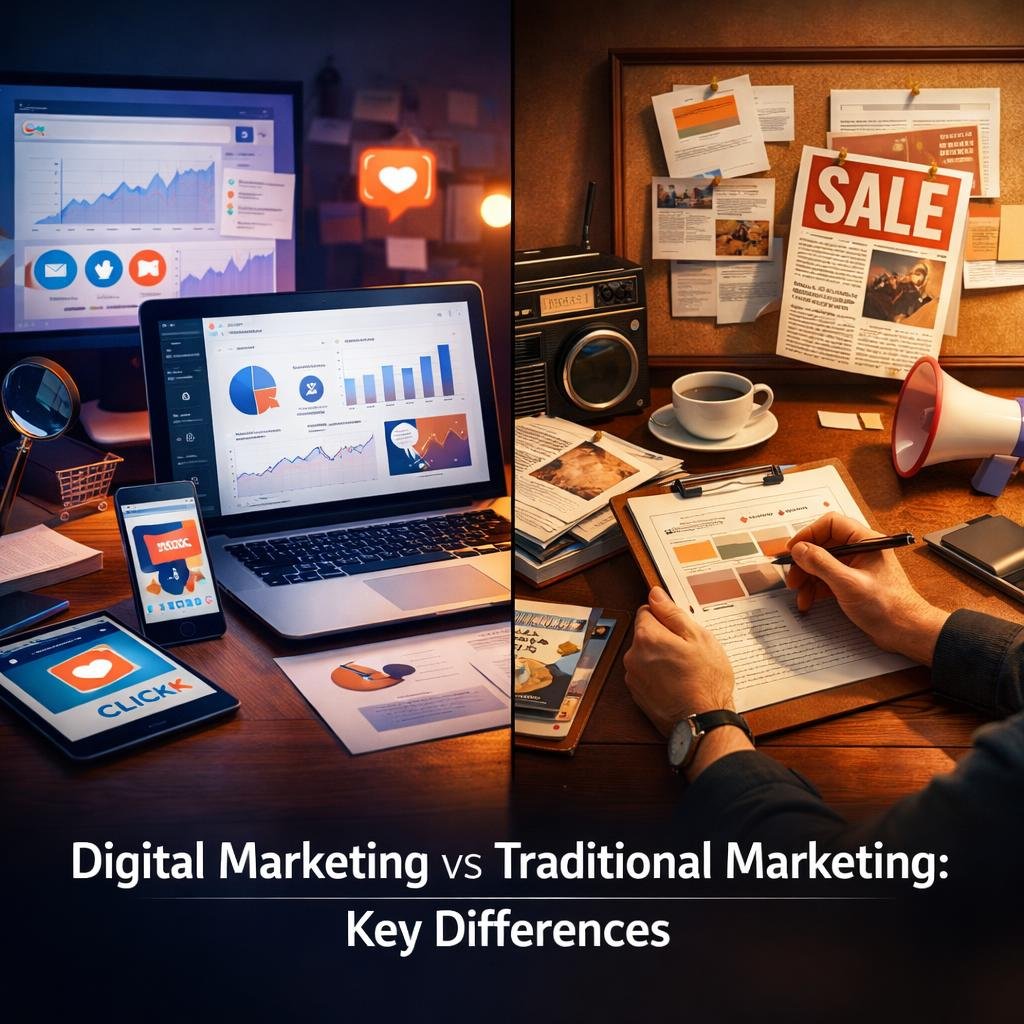
Choosing between digital marketing and traditional marketing is one of the most common strategic decisions businesses face. Both approaches have real merit, and the right choice depends heavily on your goals, budget, target audience, and industry. Understanding how each method works — and where each one excels — helps you allocate resources more effectively and build campaigns that actually deliver results.
Traditional marketing has been the backbone of brand building for generations. Television advertising, print advertising, radio advertising, billboard advertising, and newspaper advertising have shaped how consumers discover and trust brands. These channels reach broad audiences and carry a sense of permanence that digital formats sometimes lack. But they also come with higher costs, limited targeting precision, and almost no real-time feedback.
Digital marketing changed everything. Search engine optimization, social media marketing, email marketing, pay-per-click advertising, content marketing, and influencer marketing gave businesses of every size the ability to reach specific audiences, measure performance in real time, and adjust campaigns without wasting budget. The shift in consumer behavior toward online platforms made digital marketing not just an option but a necessity for most businesses today.
Digital Marketing vs. Traditional Marketing: Core Differences
Definitions, Channels, and Marketing Objectives
Traditional marketing refers to any promotional activity conducted through offline channels. This includes television advertising, radio advertising, print advertising in magazines and newspapers, direct mail, billboard advertising, and in-person events. These methods have historically been used to build brand awareness at scale, particularly for businesses targeting broad geographic or demographic groups.
Digital marketing encompasses all promotional activity conducted through online channels. This includes search engine optimization, pay-per-click advertising, social media marketing, email marketing, content marketing, mobile marketing, and search engine marketing. The primary advantage of digital marketing is its ability to connect businesses with highly specific audiences based on behavior, interests, location, and intent.
Both approaches serve legitimate marketing objectives. Traditional marketing excels at mass awareness campaigns. Digital marketing excels at targeted outreach, lead generation, and conversion rate optimization. The channel you choose should align directly with your marketing strategy and the behavior of your target audience.
| Feature | Digital Marketing | Traditional Marketing |
|---|---|---|
| Primary Channels | SEO, PPC, Social Media, Email | TV, Radio, Print, Billboards |
| Audience Targeting | Highly specific | Broad and general |
| Cost Structure | Flexible, scalable | Fixed, often high |
| Performance Tracking | Real-time data analytics | Delayed, estimated |
| Customer Interaction | Two-way, immediate | One-way, passive |
| Campaign Flexibility | High — adjust anytime | Low — fixed once launched |
Audience Reach, Targeting Precision, and Customer Interaction
Traditional marketing reaches large audiences quickly. A prime-time television advertising spot can expose your brand to millions of viewers in a single broadcast. Radio advertising and billboard advertising similarly cast wide nets across geographic regions. This makes traditional channels powerful for national brands or businesses launching major awareness campaigns.
Digital marketing offers something traditional channels cannot: precision. Through social media marketing platforms and pay-per-click advertising tools, you can target users by age, location, income level, browsing history, purchase intent, and dozens of other variables. This level of targeting precision means your budget goes directly toward the people most likely to convert.
Customer interaction is another major differentiator. Traditional marketing is largely one-directional — you broadcast a message and hope it resonates. Digital marketing enables two-way communication through comments, reviews, direct messages, and social media engagement. This real-time interaction builds stronger customer engagement and gives brands immediate feedback on how their messaging is landing.
Speed, Flexibility, and Campaign Control
Traditional marketing campaigns require significant lead time. Producing a television advertising spot, booking a print advertising slot, or designing billboard advertising materials takes weeks or months. Once launched, these campaigns are essentially locked in — changes are costly and sometimes impossible mid-campaign.
Digital marketing campaigns can be launched, paused, or modified within hours. A pay-per-click advertising campaign can go live the same day it is created. If a social media marketing post underperforms, you can adjust the copy, creative, or targeting immediately. This flexibility gives businesses far greater control over their marketing strategy and spending.
For businesses that need to respond quickly to market shifts or consumer behavior changes, digital marketing is the clear winner on speed and adaptability. Traditional marketing simply cannot match that level of campaign control.
Feature-by-Feature Comparison of Digital and Traditional Marketing
Cost Structure, Budget Requirements, and Pricing Models
Traditional marketing typically involves high upfront costs with fixed pricing models. A television advertising campaign can cost tens of thousands of dollars for production alone, before factoring in airtime. Print advertising in major publications, radio advertising slots, and billboard advertising placements all carry significant minimum spend requirements that put them out of reach for many small businesses.
Digital marketing offers far more flexible cost structures. Pay-per-click advertising lets you set daily budgets as low as a few dollars. Email marketing platforms charge based on subscriber count. Social media marketing can be done organically at no cost or amplified with paid promotion at any budget level. If you’re exploring practical SEO strategies for small businesses, you’ll find that organic search traffic is one of the most cost-effective long-term investments available.
Cost-effectiveness is one of the most compelling reasons businesses shift budget toward digital marketing. The ability to start small, test campaigns, and scale what works makes digital channels accessible to businesses at every stage of growth.
Performance Measurement, Attribution, and Return on Investment
Measuring return on investment in traditional marketing is notoriously difficult. Television advertising and radio advertising rely on estimated audience figures and surveys. Print advertising and newspaper advertising track circulation numbers, not actual engagement. Attribution — knowing which channel drove a specific sale — is largely guesswork in traditional marketing.
Digital marketing transforms performance measurement. Data analytics tools track every click, impression, conversion, and customer journey touchpoint in real time. Search engine optimization performance is tracked through keyword rankings, organic traffic, and conversion rate data. Pay-per-click advertising platforms report cost-per-click, cost-per-acquisition, and return on investment automatically.
This transparency makes it significantly easier to optimize campaigns and justify marketing spend. When you know exactly which channels are driving revenue, you can allocate budget with confidence rather than relying on estimates.
Brand Visibility, Credibility, and Customer Experience
Traditional marketing still carries a credibility advantage in certain contexts. Consumers often perceive television advertising and print advertising in reputable publications as signals of an established, trustworthy brand. There is a psychological weight to seeing a brand in a physical newspaper or on a billboard that digital ads sometimes struggle to replicate.
Digital marketing builds brand awareness through consistent, multi-channel presence. Search engine optimization ensures your brand appears when potential customers are actively searching for solutions. Social media marketing keeps your brand visible in daily feeds. Content marketing positions your business as an authority in your field. Understanding what makes a strong brand identity stand out is essential to making all of these digital touchpoints work together cohesively.
Customer experience is increasingly shaped by digital interactions. Mobile marketing, personalized email marketing, and responsive online advertising create experiences that feel relevant and timely. Traditional marketing delivers the same message to everyone — digital marketing can tailor the experience to the individual.
Scalability, Personalization, and Data Privacy Considerations
Scalability is a major advantage of digital marketing. A social media marketing campaign that performs well can be scaled up with additional budget in minutes. Search engine optimization compounds over time — the more content and authority you build, the more organic traffic you attract without proportional cost increases. Traditional marketing does not scale in the same way; reaching more people typically means spending proportionally more money.
Personalization is where digital marketing truly separates itself. Email marketing platforms allow dynamic content that changes based on subscriber behavior. Pay-per-click advertising and social media marketing platforms serve different ads to different audience segments. Influencer marketing connects brands with niche communities through trusted voices. This level of personalization improves customer engagement and conversion rates significantly.
Data privacy is an important consideration in digital marketing. Consumer behavior tracking, cookie-based targeting, and data analytics practices are subject to evolving regulations. Businesses must ensure their digital marketing practices comply with applicable privacy laws and maintain consumer trust. Traditional marketing, by contrast, collects far less personal data and faces fewer regulatory constraints in this area.
Unique Strengths and Best Use Cases
When Digital Marketing Is Best: E-commerce, Startups, and Niche Audiences
Digital marketing is the natural home for e-commerce businesses. Search engine optimization drives product discovery. Pay-per-click advertising captures high-intent shoppers. Email marketing nurtures repeat purchases. Social media marketing builds community around products. The entire customer journey — from awareness to purchase to retention — can be managed and measured through digital channels.
Startups benefit enormously from digital marketing’s cost-effectiveness and flexibility. With limited budgets, startups can test multiple channels simultaneously, identify what works, and scale quickly. Content marketing and search engine optimization build long-term organic traffic without ongoing ad spend. Influencer marketing can generate brand awareness within niche communities at a fraction of traditional advertising costs.
Niche audiences are almost impossible to reach efficiently through traditional marketing. A business serving a very specific consumer behavior pattern or interest group would waste most of a traditional advertising budget reaching irrelevant audiences. Digital marketing’s targeting precision makes it possible to reach exactly the right people, wherever they are online.
When Traditional Marketing Is Best: Local Businesses, Mass Awareness, and Older Demographics
Local businesses with strong community ties often benefit from traditional marketing. A local restaurant, law firm, or retail shop can build significant brand awareness through local newspaper advertising, radio advertising, and strategically placed billboard advertising. These channels reach local audiences effectively and reinforce a sense of community presence.
Mass awareness campaigns for consumer goods, political campaigns, or major product launches still benefit from the broad reach of television advertising. When the goal is to reach as many people as possible regardless of specific targeting, traditional marketing channels deliver scale that digital marketing struggles to match in a single touchpoint.
Older demographics remain more reachable through traditional channels. Consumers who spend less time online and more time with television, radio, and print publications are better served by traditional marketing. A marketing strategy that ignores this reality risks missing a significant and often high-value segment of the market.
Integrated Campaigns: Combining Online and Offline Channels
The most effective marketing strategies do not choose between digital and traditional — they integrate both. A television advertising campaign can drive viewers to a website where search engine optimization and pay-per-click advertising capture their intent. A billboard advertising placement can include a QR code linking to a landing page optimized for conversion rate. Print advertising can promote social media marketing channels that build ongoing customer engagement.
This integrated approach is sometimes called omnichannel marketing, and it recognizes that consumers move fluidly between online and offline environments. A customer might see a radio advertising spot, search for the brand online, read content marketing articles, and then convert through an email marketing campaign. Each touchpoint reinforces the others.
Building a coherent integrated campaign requires a clear unique value proposition that translates consistently across every channel. Whether your message appears on a billboard or in a pay-per-click ad, the core promise to your customer must remain consistent and compelling.
Conclusion
Digital marketing and traditional marketing are not enemies — they are complementary tools with different strengths. Digital marketing wins on targeting precision, cost-effectiveness, real-time data analytics, and flexibility. Traditional marketing wins on broad reach, credibility in certain contexts, and effectiveness with audiences less engaged online.
The smartest marketing strategy is one that understands these differences and deploys each channel where it performs best. For most businesses, digital marketing will form the foundation of their efforts, with traditional channels playing a supporting role where appropriate. The key is to stay focused on your target audience, measure your return on investment rigorously, and never stop testing.
FAQ
Is digital marketing cheaper than traditional marketing?
Generally, yes. Digital marketing offers far more flexible cost structures than traditional marketing. Pay-per-click advertising, email marketing, and social media marketing can all be started with modest budgets and scaled based on performance. Traditional marketing channels like television advertising and print advertising typically require significant upfront investment with less flexibility. That said, cost-effectiveness depends on your goals — a well-placed billboard advertising campaign in the right location might outperform a poorly managed digital campaign at a similar spend.
Which marketing method provides better return on investment?
Digital marketing typically delivers more measurable and often higher return on investment because of its precise targeting and real-time data analytics. You can track exactly which campaigns drive conversions and optimize accordingly. Traditional marketing return on investment is harder to measure because attribution is less precise. However, for mass awareness goals, traditional channels can deliver strong brand awareness results that indirectly support long-term return on investment. The best approach is to measure both and allocate budget based on actual performance data.
Can businesses use digital and traditional marketing together?
Absolutely, and many successful brands do exactly this. Combining television advertising or billboard advertising with search engine optimization, social media marketing, and email marketing creates multiple touchpoints that reinforce each other throughout the customer journey. Consumer behavior research consistently shows that customers exposed to both online and offline messaging convert at higher rates than those reached through a single channel. An integrated marketing strategy that aligns messaging across all channels delivers the strongest overall results.